evidence-first code intelligence
Meeba Brain is an evidence-first code intelligence layer for teams using AI coding tools. It traces impact and root causes across large codebases, cites the exact code behind every claim, and marks what it couldn't verify.
Meeba Brain is a read-only GitHub tool. Every reference in its answers is checked against your code before you see it, and anything it can't confirm is marked — so you know what to trust before you act on it.
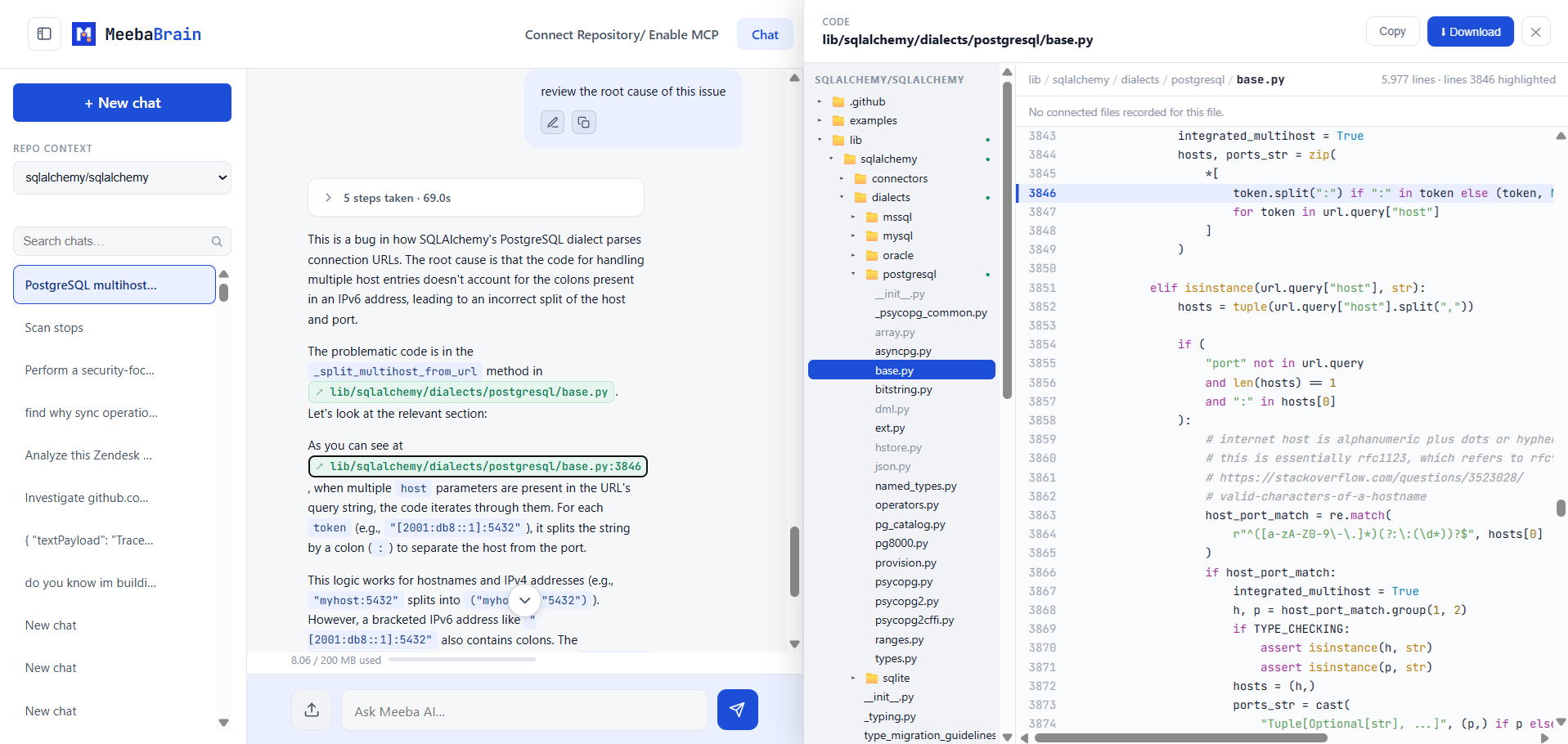
host on :, so a bracketed IPv6 address like [2001:db8::1]:5432 is cut in the wrong place — see ↗ lib/sqlalchemy/dialects/postgresql/base.py:3846.
Meeba Brain doesn't summarize your code from nearby text. It parses the actual structure — callers, callees, routes, dependencies — into a graph, reads the relevant files in full, then checks every reference against your code before the answer ships.
Real AST parsing across your repo builds callers, callees, routes and dependencies — not a proximity guess from embeddings.
That structure becomes a queryable code graph, so an answer about one function can trace every place it's actually used.
Every file and line it cites is checked against your code. Wrong references are fixed before you see them; anything still unconfirmed is marked, not hidden.
No badges to decode. The answer says what it confirmed in the code, what is a hypothesis, and what it couldn't determine — and the evidence is one click away.
Above every answer: how many references were confirmed against your code, how many files were read, and how long it took.
Every claim points to the code behind it. Click a reference and the file opens inside Meeba Brain, lines highlighted, with the files it uses and is used by.
For bugs, the chain from what happened to what broke is drawn as a step-by-step flow, each step linked to its code.
If something can't be confirmed in the repo, it's marked and said in plain words — not dressed up as a confident answer.
The same grounded graph and checked references, right inside the tools on your machine — no new tab, no new habit to build.
Meeba Brain needs to read your code to build the graph — it never needs permission to change it. Public repos connect with just their URL; private repos use a read-only token you can replace or revoke any time.
The permission scope is read-only, on purpose. Nothing below is possible, even if asked.
Skip the access conversation entirely — point Meeba Brain at any public GitHub repo and try a real question before connecting anything private.
Try on a public repo →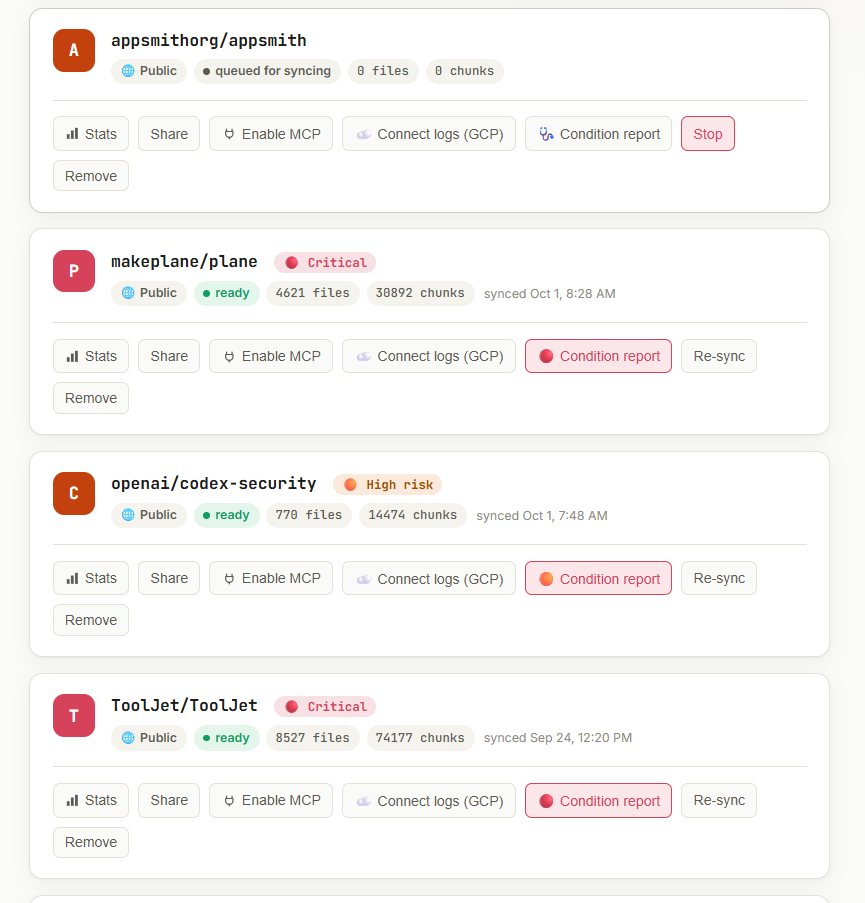
The free plan is enough to try Meeba Brain on a real bug. Upgrade when you want more usage, deeper investigations or more repositories — prices shown in your local currency, taxes included.
A public write-up of Meeba Brain on an open-source SDK change: what it found, the exact lines behind each finding, and what it got wrong.
ComposioHQ/composio · issue #5022 · pull request #5024
Asked about the proposed fix, Meeba Brain traced the behaviour changes in custom_tool.py, linked them to the new regression tests, and flagged a possible compatibility risk from changing a private function's return value. It read 7 files in about five and a half minutes.
Where it fell short: it gave one test the wrong name, and its compatibility risk still had to be checked against the function's callers by hand. The case study shows both next to the real code.
Independent analysis. Not an endorsement by Composio, and the pull request is not merged.
"I tested it on a real PDF parsing bug. It understood the underlying error context and gave a more accurate fix than the AI tools I normally reach for."
Akshat Tamrakar · Full Stack Developer, tested on a live production bug
The things people ask before connecting a repo.
An evidence-first code intelligence layer for teams using AI coding tools. It shows what a code change really affects across your codebase and traces root causes, citing the exact files and lines behind every claim and marking what it couldn't verify. It connects to GitHub with read-only access.
No. It only requests read-only access to repository contents to build its code graph. It cannot write, push, or delete branches, files, or the repository, even if asked.
Before an answer is shown, every file and line it cites is checked against your synced code. Wrong line numbers are corrected, and references that still can't be confirmed are marked unverified. Above each answer you see how many references were verified, how many files were read and how long it took. In the answer itself, Meeba Brain says plainly what it confirmed in the code, what is a hypothesis, and what it couldn't determine from the repo.
Yes, you can start free. The free plan includes a daily usage allowance and needs no credit card or phone number. Paid plans add more usage, deeper investigations and more repositories — see pricing.
Yes. It runs as an MCP server, so the same evidence-backed code graph is available inside Cursor and Claude Code, not just in the web chat.
Yes. Point Meeba Brain at any public GitHub repository and ask a real question before connecting or granting access to a private one.
Most AI coding assistants answer from text proximity or embeddings, which can sound confident while being wrong. Meeba Brain builds an actual AST-based code graph of your repository, reads the relevant files in full, and checks every file and line it cites before showing you the answer — so you can click any reference and see the real code.
Meeba Brain runs as an MCP server that connects to Cursor and Claude Code, so once it's connected you can query the same code graph from inside your editor without switching tabs.
Engineering teams of roughly 20 to 150 engineers using AI coding tools, where one change can reach code nobody on the pull request has read and a confident wrong answer is expensive.
Code review tools comment on the pull request. Meeba Brain focuses on what a change affects outside its diff, such as a shared function whose callers in other modules break.
Yes. A public case study on the Composio Python SDK (issue #5022, pull request #5024) shows Meeba Brain's analysis of a proposed fix, with links to the exact lines and where it fell short. It is an independent analysis, not an endorsement by Composio.
Don't evaluate it in the abstract. Connect a public repo, paste the bug you're stuck on right now, and see whether the evidence holds up.
no credit card · read-only GitHub access
Create free account → Already have an account? Sign inSignup takes under a minute — just email and a password, or continue with Google or GitHub.